

Events
The Data Metering — Events section provides visibility into the raw event data used for usage tracking, metering, and downstream billing calculations within Vayu. It lets teams review incoming event activity, validate ingestion workflows, and monitor the data that powers usage-based pricing models.
Events represent incoming activity before aggregation or billing calculations are applied. They are the foundational data layer for usage calculations across the platform, including product telemetry, customer activity, and metering troubleshooting.
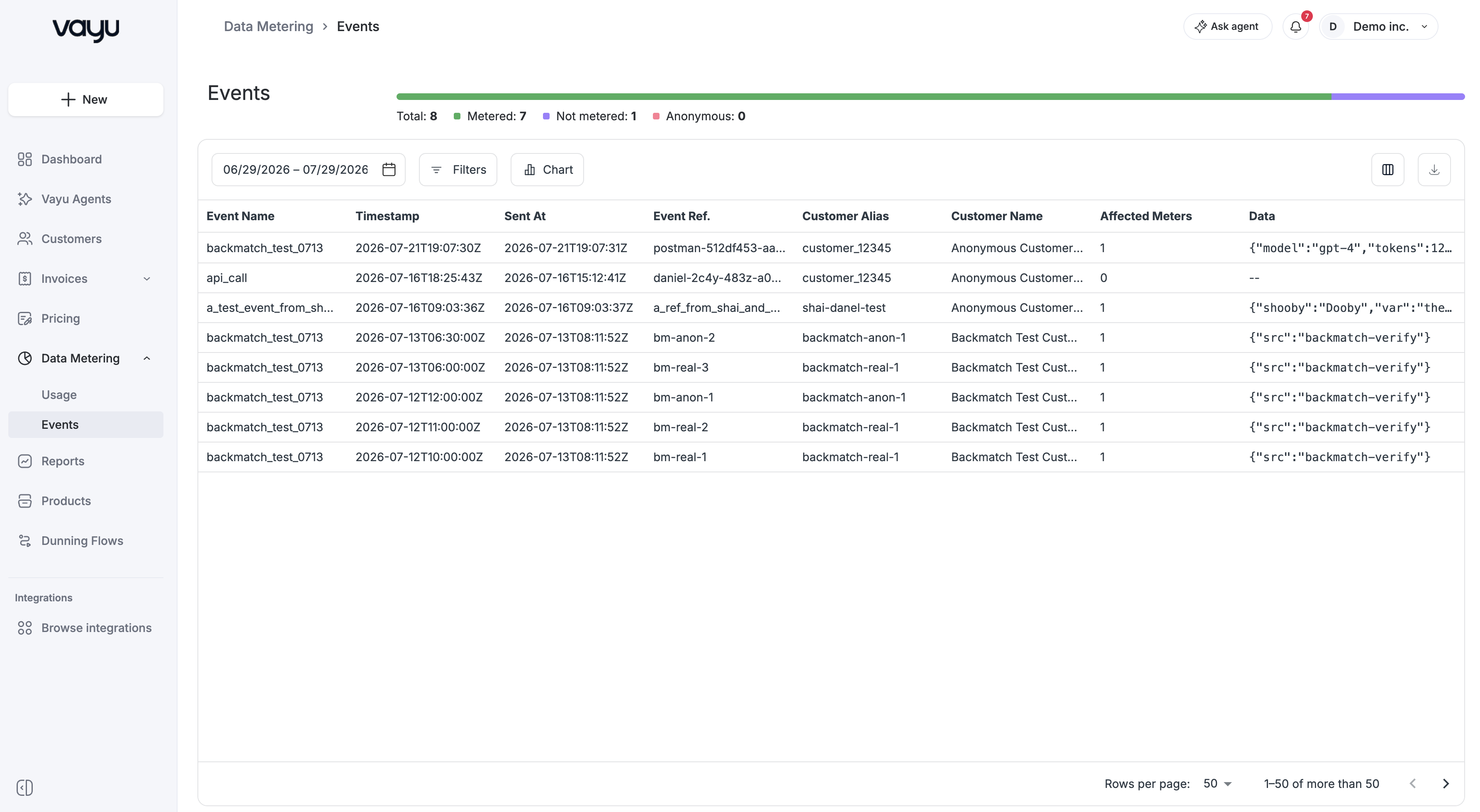
At the top of the page, tools help you filter and review events by date, event name, reference, customer, status, and event-specific data. Below that, event records are displayed in an operational view designed for metering workflows and billing validation.
Filters
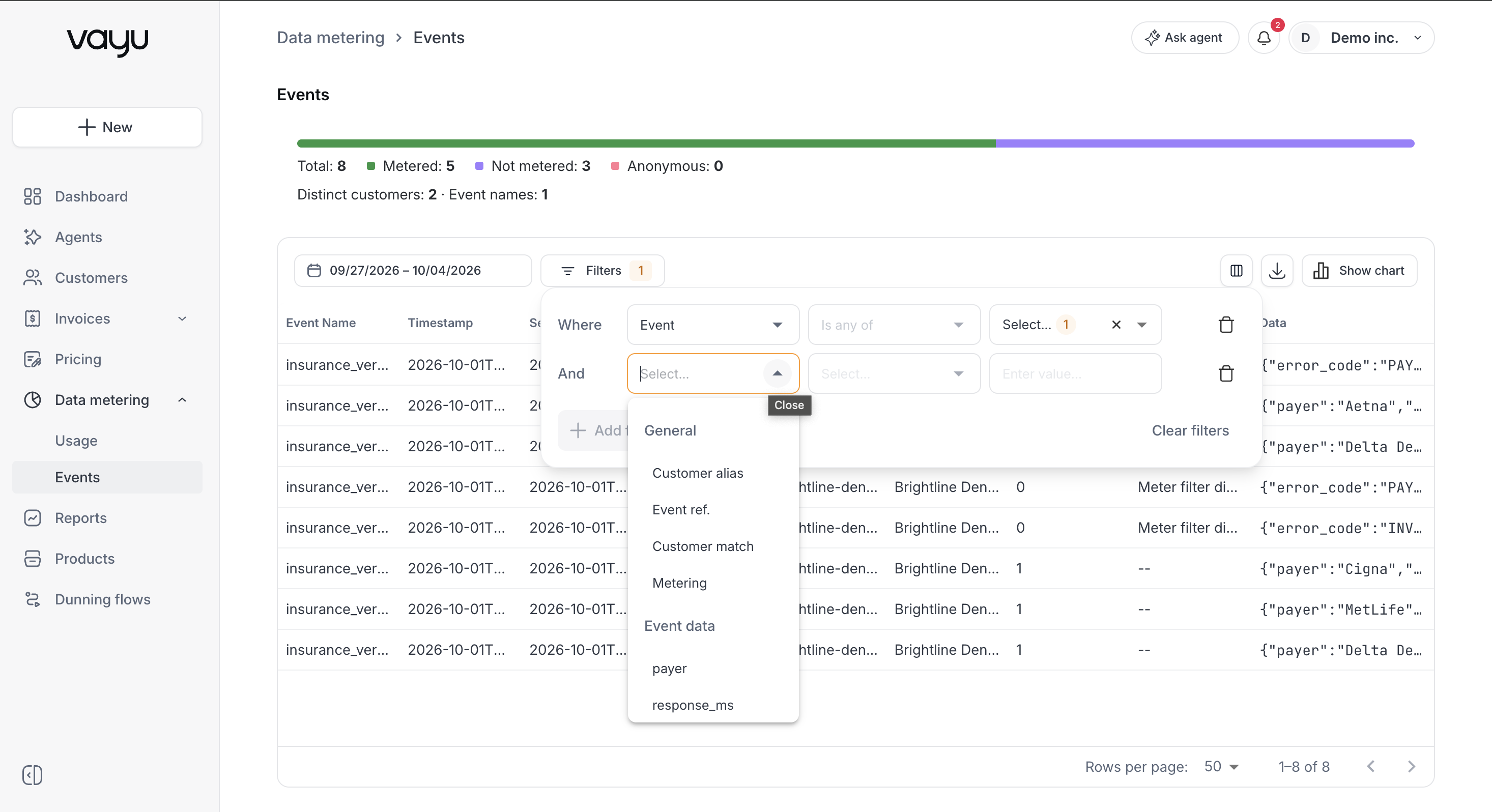
You can combine one or more filter conditions to narrow the event list:
- Date range – Limits results to a specific event or billing period.
- Event name – Shows events with the selected name or type.
- Ref – Finds an event using its reference identifier.
- Customer alias – Shows events associated with a specific customer alias.
- Customer match – Filters events according to whether they were matched to a customer.
- Metering status – Filters events according to whether they were metered.
- Event data – Filters by event-specific fields when available for the selected event type.
For each condition, select a field, operator, and value. Add further conditions when you need to narrow the results.
Event Status and Chart Controls
The clickable status counter bar shows the number of metered, not metered, and anonymous events. Select a segment to apply that status as a filter.
The page also includes a collapsible chart for reviewing event volume and processing patterns. Use the Sent time and Billing time toggle to display events according to when they were sent to Vayu or when they are considered for billing.
Events Table
The events table displays incoming event records and their processing state. Columns include:
- Event name – The type of event or usage metric.
- Timestamp – The event timestamp.
- Sent At – When the event was sent to Vayu.
- Customer alias – The customer identifier supplied with the event.
- Customer Name – The matched customer name, when available.
- Ref – The event reference ID.
- Affected Meters – The meters affected by the event.
- Unmetered Reason – The reason the event was not metered, when applicable.
- Event data – Additional event properties and metadata.
Event Detail Drawer
Select an event row to open its detail drawer. The detail drawer shows event-level information for troubleshooting and validation.
When multiple versions exist for the same reference, the drawer includes per-ref version history so you can review how the event changed over time.
Search Events
Use event search to query and filter usage events recorded in Vayu. This allows you to analyze customer activity, verify metered usage, and troubleshoot billing discrepancies.
Searching Events Through the UI
To view events in the Vayu interface:
- Navigate to Data Metering → Events.
- Select the relevant date range.
- Use Filters to add and combine the conditions described above.
- Optionally select metered, not metered, or anonymous in the status counter bar.
- Select an event row to open its detail drawer.
Searching Events Through the API
For more advanced filtering and larger result sets, use the API to query events.
Query events endpoint
GET /eventsQuery parameters can include startTime, endTime, eventName, limit, and cursor.
Example: This request returns up to 100 api_call events from November 2023.
GET /events?startTime=2023-11-01T00:00:00Z&endTime=2023-11-30T23:59:59Z&eventName=api_call&limit=100Example response
{
  "events": [
    {
      "name": "api_call",
      "timestamp": "2023-09-13T18:25:43.511Z",
      "customerAlias": "customer_12345",
      "ref": "4f6cf35x-2c4y-483z-a0a9-158621f77a21",
      "data": {
        "key1": "processing_duration",
        "key2": "api_url"
      },
      "id": "<string>",
      "createdAt": "2023-11-07T05:31:56Z",
      "updatedAt": "2023-11-07T05:31:56Z"
    }
  ]
}
Common Search Scenarios
Find Events for a Specific Customer
Query events by customer alias and time period to see all activity for that customer.
GET /events?startTime=2023-11-01T00:00:00Z&endTime=2023-11-30T23:59:59Z&customerAlias=customer_12345Verify Usage for Billing Period
Search events within a billing period to verify metered usage before invoice generation.
GET /events?startTime=2023-10-01T00:00:00Z&endTime=2023-10-31T23:59:59Z&eventName=compute_hoursTroubleshoot Missing Charges
Query events by event name to identify if usage was recorded but not billed.
GET /events?eventName=storage_gb&startTime=2023-11-01T00:00:00Z&endTime=2023-11-30T23:59:59ZAnalyze Usage Patterns
Retrieve larger datasets to analyze usage trends and patterns.
GET /events?startTime=2023-01-01T00:00:00Z&endTime=2023-12-31T23:59:59Z&limit=1000Event Availability and Pagination
Events are available after submission. Use event search for live monitoring, troubleshooting, and billing validation.
For large result sets, use cursor-based pagination. Make an initial request with a limit parameter, then use the returned cursor in the next request to retrieve additional results.
Pricing Events
Pricing events, also called measurements, are raw usage data points sent to Vayu to power usage-based billing. Each event represents a billable action or consumption that occurred in your product.
Pricing events include an event name, customer identifier, timestamp, quantity, and metadata.
Ingestion
API Ingestion
Send events directly to Vayu's ingestion API.
POST /events
{
  "eventName": "api_call",
  "customerId": "customer_123",
  "timestamp": "2024-03-17T10:00:00Z",
  "quantity": 1,
  "metadata": {
    "endpoint": "/users",
    "method": "GET"
  }
}
Batch Ingestion
For high-volume scenarios, send events in batches to reduce API overhead.
Data Warehouse Integration
Connect your data warehouse to automatically sync usage data to Vayu on a scheduled basis.
Event Processing
Once ingested, pricing events flow through Vayu's processing pipeline:
- Validation checks required fields and data integrity.
- Enrichment attaches customer and product data to each event.
- Aggregation groups and sums events according to the pricing configuration.
- Rating converts aggregated usage to billable amounts based on pricing tiers.
- Invoicing uses rated usage on customer invoices.
Event Requirements
Each pricing event must include a unique event ID, customer identifier, event name, timestamp, and quantity.
Use idempotency keys to prevent duplicate charges from retry logic. Include rich metadata to support detailed usage analysis and debugging.