

Usage-Based Fees
Usage-based fees cover metered usage, pricing tables, meter resets, meter refills, commitments, base amounts, and overages. Vayu supports tiered pricing, volume pricing, per-unit pricing, revenue sharing, tiered subscriptions, grouped products, matrix pricing, and SQL metering.
Use this page to understand the pricing models available for usage-based products. For detailed commitment and base amount configuration, see Base Amount and Commitment.
Defaults
Usage accumulation is set to monthly by default unless another meter reset cadence is configured. Subscriptions are billed upfront on a monthly basis by default unless schedule settings are changed.
Defaults can be changed from the product's Modify drawer when the relevant setting is available for that product type.
Meter Reset and Meter Refill
Meter reset defines when metered usage counters start over, such as monthly, quarterly, or annually. It controls the measurement window for usage, commitments, and overages.
Meter refill defines whether a credit or commitment balance is replenished, and when that replenishment occurs. Reset controls the usage window; refill controls the available balance.
Configure meter reset before finalizing commitment or credit behavior because commitment and credit calculations depend on the metering window.
Tiered Pricing
Tiered pricing bills usage at the price for each tier the usage falls into. Unit price changes by tier within each metering window.
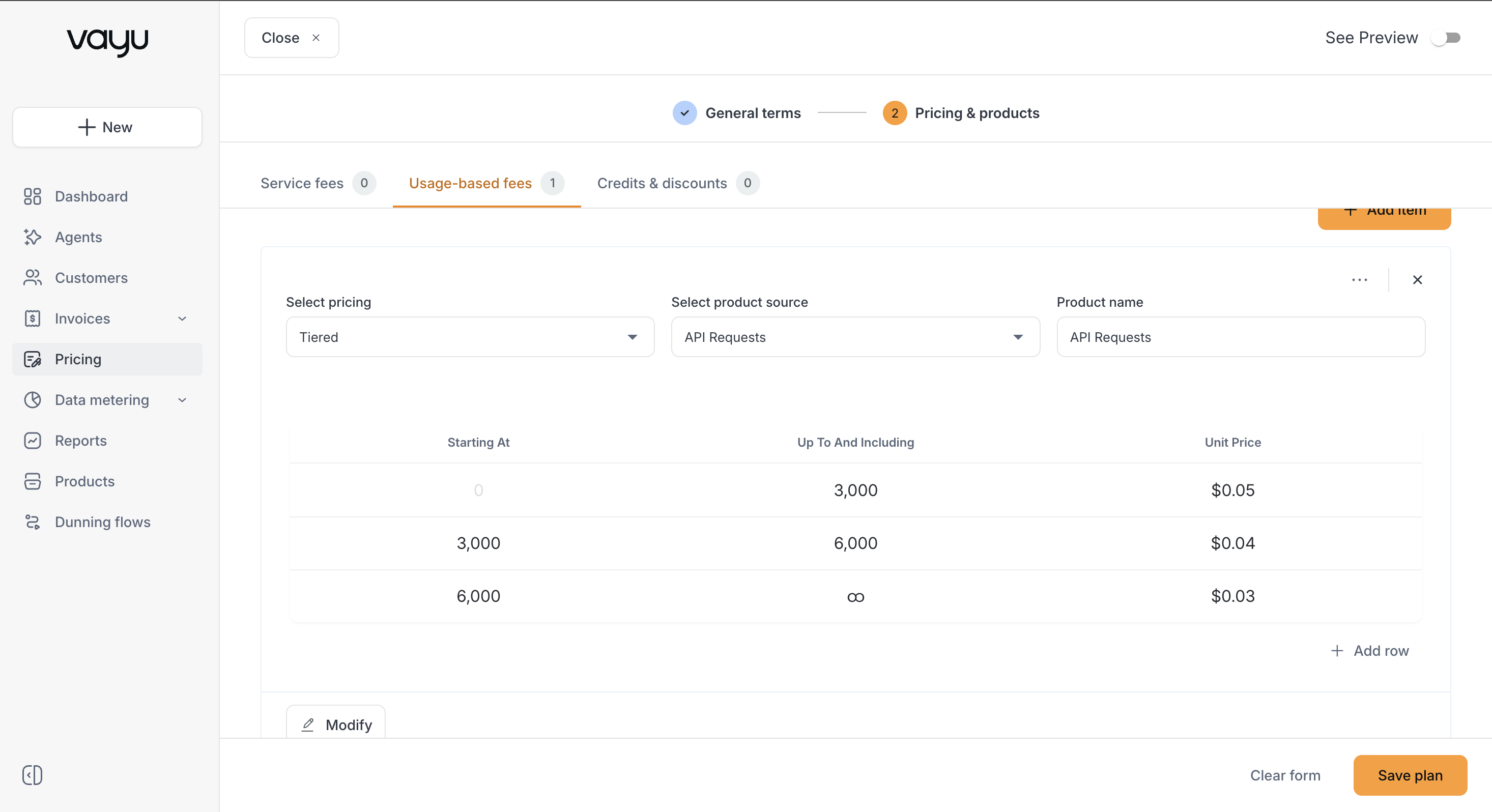
In this example, tiered charges would be calculated as follows when consuming 9,000 units:
| Tier | Units | Price per unit | Cost |
|---|---|---|---|
| First 3,000 units | 3,000 | $0.05 | $150.00 |
| Next 3,000 units | 3,000 | $0.04 | $120.00 |
| Last 3,000 units | 3,000 | $0.03 | $90.00 |
| Total | 9,000 | $360.00 |
Tiered products can also support Add Flat rate, which adds a flat charge to the tiered usage configuration when that pricing structure is required.
The billing interval describes how often charges are billed. Meter reset describes when usage counters reset. You can meter monthly but invoice the resulting overage quarterly.
Volume Pricing
With volume pricing, the unit price is selected based on total aggregated usage. Once usage reaches a tier, that tier's price applies to all units in the measurement period.
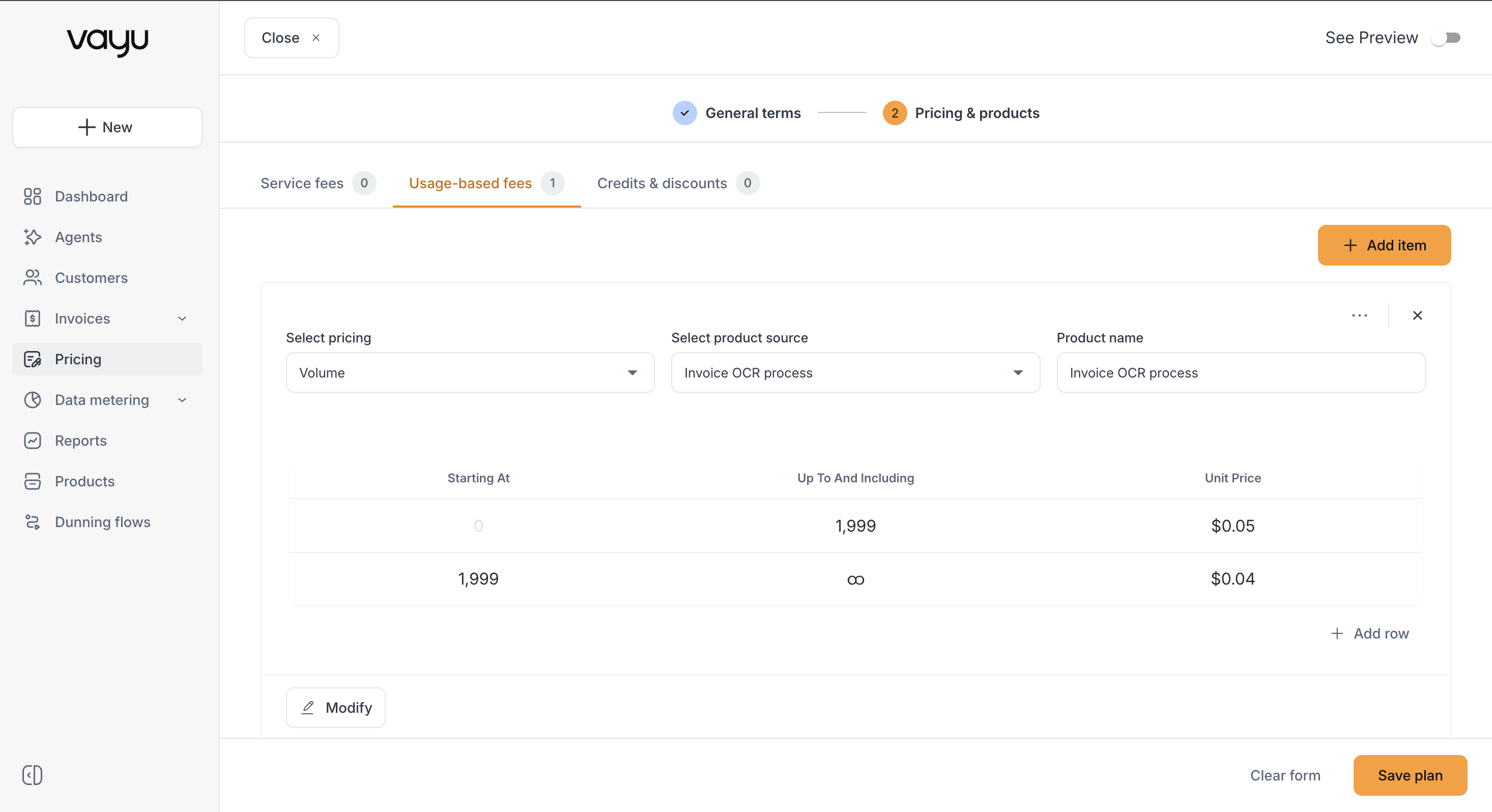
| Volume tier | Price per unit |
|---|---|
| 0 – 1,999 | $0.05 |
| 1,999 and above | $0.04 |
Example: If a customer consumes 9,000 units, the entire volume falls in the "1,999 and above" tier, so the charge is 9,000 × $0.04 = $360.
Volume products can also support Add Flat rate, which adds a flat charge to the volume pricing configuration when needed.
Per-Unit Pricing
Per-unit pricing bills every unit of usage at a single fixed rate. The unit price does not change as usage increases.
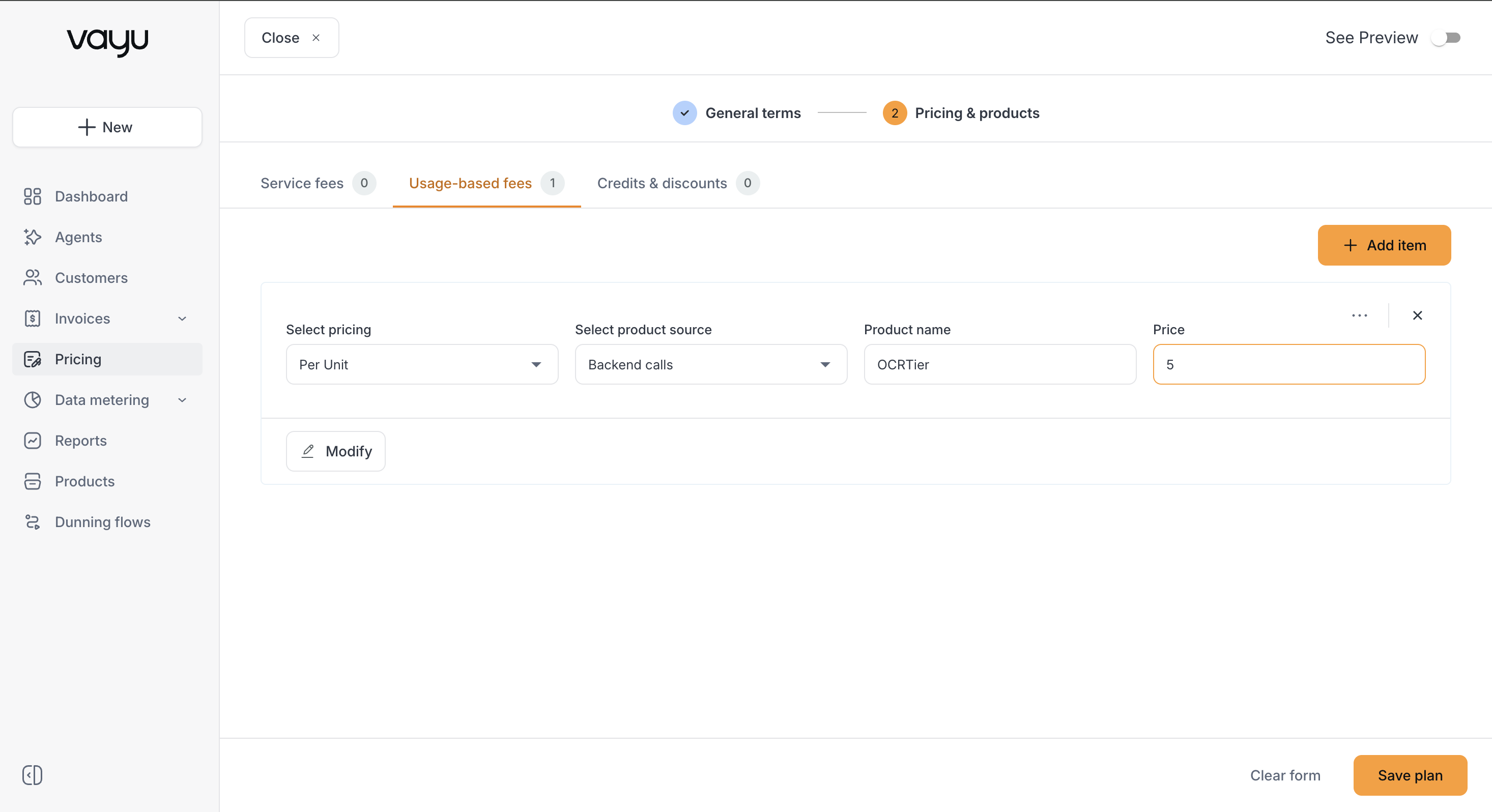
To adjust a per-unit product, select Modify. Available settings can include base amount, commitment, bulk pricing, meter reset, and credit allocation.
Example: If the product is priced at $5 per unit and the customer consumes 5,000 units, the usage charge is $25,000.
Tiered Subscription
For tiered subscriptions, a flat recurring charge applies based on the customer's tier for each billing period. By default, subscriptions are billed upfront on a monthly basis.
To edit a tiered subscription, select Modify. Available settings can include product ID, automatic upgrade, product description, payment schedule, period, billing interval, and applicable pricing behavior.
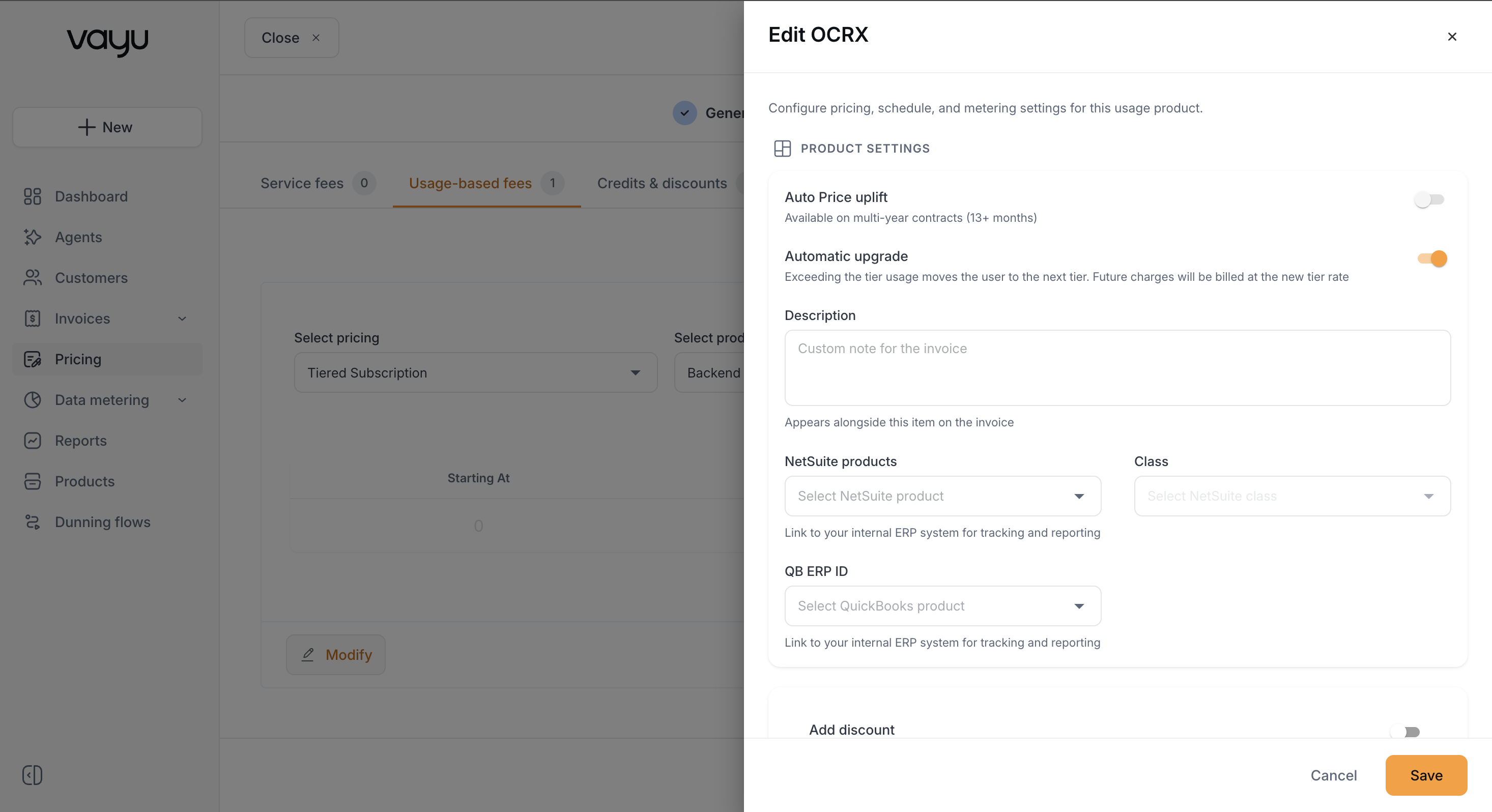
Automatic upgrade means that when a customer crosses into a higher tier, the customer can be upgraded to the new tier according to the configured rules.
Revenue Share
Revenue share is a usage model that charges a percentage of consumed volume for the billing period. It is similar to volume pricing, but the unit price is a percentage of a transaction amount or other measured value.
For percentage-based volume pricing, you can optionally set a minimum and maximum fee threshold.
Example: Charge 0.5% of every payment event with a $1 minimum and a $10 cap per payment.
To edit a revenue-share product, select Modify. Available settings can include NetSuite product ID, product description, schedule, data metering, commitment, and base amount.
Credits Allocation
Usage-based products can use credits allocation when usage credits should apply to specific products or metered usage fees. Configure credit allocation from the promotion or product settings, depending on whether the credit applies at the contract level or product level.
Grouped Products (Bundle)
Grouped products let multiple metered products draw from the same commitment or base amount. Each product can still keep its own pricing table.
Example: A customer receives an allotment of 2,000 messages that can be used across SMS and WhatsApp. SMS and WhatsApp can each have separate overage pricing, while the shared allotment applies across both products.
When there is overage consumption on grouped products, overage is billed according to the pricing of each individual product.
Matrix Pricing
Matrix pricing defines unit prices in a grid based on two dimensions, such as usage amount, region, instance type, or customer segment. Each combination of dimension values has a specific rate.
This lets you charge different prices for the same metric depending on where and how it is used, without creating separate products for each variation.
SQL Metering
SQL metering is an advanced metering mechanism that allows pricing logic to be expressed using SQL-like conditions. It supports calculations that cannot be expressed using standard field-based or rule-based metering alone.